
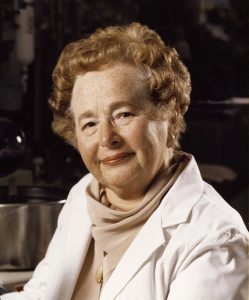
Gertrude Elion. Wikimedia Commons.
By Barbara Pfeffer Billauer
When Jewish research scientist Gertrude Elion arrived in the Research Triangle in 1970, North Carolina was built on industry and agriculture. The state aspired to reinvent itself as a global high-tech center, and no event confirmed its arrival more than the Nobel Prize in Medicine Gertrude would win in 1988.
About 46,000 organ transplants are performed a year in the US; their success is, in large measure, is due to the pioneering work of Gertrude Elion. So, too, are we indebted to this remarkable woman for medications used to treat leukemia, malaria, cancer, and infections such as meningitis and sepsis. With grit, determination, stubbornness, and relentless effort substituting for a PhD, Gertrude Elion, in partnership with Dr. George Hitchings, revolutionized the way drugs are created—serving as the foundational methodology for drug discoveries performed today.
Born in 1918 to Eastern European Jewish parents, Gertrude, “Trudy” grew up in the Bronx, then home of relatively affluent Jews. She distinguished herself as a student early on, crediting her stubbornness, perseverance in the face of nay-sayers, and insatiable quest for knowledge for her achievements. The Depression forced Gertrude’s father, a dentist, into bankruptcy. But, the financial crash seemed to little effect the young Gertrude, who was far more influenced by the death of her grandfather from stomach cancer when she was 15 (her mother died a year later), driving her to finding a cure, while eschewing her father’s nudges to follow in his footsteps into dentistry and fulfilling her mother’s wish for her to have a career.
After a distinguished tenure at Hunter College, she earned a Master’s degree in Chemistry at NYU in 1941 (rejecting biology because she didn’t like dissection). Women were relegated to teaching or nursing and, like many female scientists of her day, Gertrude was challenged to find a position commensurate with her talents and brains. She began her working life teaching chemistry and working as a secretary, eventually becoming a technician at A&P—measuring acidity and contamination in foods. But her first love was research, and that she wasn’t doing.
After more years of perseverance, unpaid work, and painful rejections, including one for being too attractive, a chance event favored her future. In 1944 she purchased a bottle of aspirin at a local pharmacy and noticed it was manufactured by Burrough’s Welcome (now GSK). On a whim, she contacted the company and asked if they had laboratory openings. They did, launching a collaboration with Dr. Geroge Hitchings and a path to a Nobel Prize.
The Pioneering Methodology
Gertrude began her research into the uncharted world of nucleic acid biosynthesis, focusing on the purine molecule, a critical component of DNA. At the time, drug research involved an ad hoc trial and error approach, and Gertrude and George stood the prevailing methodology on its head. Instead of tweaking a potential drug’s chemical structure to fit a disease, she reverse-engineered the process, focusing on understanding the pathogens involved in a particular disease and tailoring the drug to fit the pathogen.
Their revolutionary approach examined biochemical differences between healthy cells and diseased cells, whether stricken with cancer, bacteria, or viruses. Synthesizing antagonists (or blockers) to the nucleic acids needed for diseased cells metabolism, they tricked the pathogens into accepting the lethal drugs as part of their biological pathway, killing or blocking diseased cells from replicating while leaving healthy cells intact.
As the Nobel Foundation explained, “Understanding that all cells require nucleic acid to reproduce, they reasoned that rapidly growing bacteria and tumors require even more to sustain the pace of growth. Find a way to disrupt their lifecycle, and you find a way to stop disease.”
Gertrude’s first success came in 1950 with an anti-leukemia drug, enabling her to fulfill her childhood dream of combatting cancer. In 1957, she discovered an immuno-suppressive agent that facilitates organ transplants. By blocking the body’s normal reaction of immunologically attacking all objects the body identifies as “foreign,” they avoided the typical organ rejection and failure.
For this new methodology, called “Rational Drug Design,” Gertrude and George shared the Nobel Prize for Medicine in 1988. Overturning the prevailing wisdom that creating effective and selective antiviral agents was impossible, Gertrude and George’s approach led to other crucial drugs, including acyclovir, an antiviral, used to treat infections caused by the herpes simplex virus and the varicella-zoster virus. The new methodology also enabled Gertrude’s students to discover the therapeutic potential of AZT, a discarded anti-cancer drug, to treat AIDS.
The Hero’s Dilemma
When Gertrude began at Burroughs Welcome, she decided that she needed a PhD to advance, and enrolled at Brooklyn Polytech, a two-hour commute from company headquarters in upstate New York. While this might demonstrate extreme commitment to some, Polytech’s dean felt otherwise, requiring Gertrude to choose between her job and a PhD. Luckily, she chose the former.
In addition to her Nobel, Gertrude would register 45 pharmaceutical patents and be awarded 25 honorary degrees. She was named to the National Inventors Hall of Fame in 1991, and she created and headed GSK’s Department of Experimental Therapy.
The final lines of her bio on the Nobel website are a fitting tribute to Gertrude’s accomplishments:
“Simply put, Elion changed the way researchers develop drugs. As a result, although she died in 1999 at the age of 81, Gertrude Elion is still saving lives.”
A more detailed version of this article appeared on the American Council on Science and Health website at https://www.acsh.org/news/2025/05/22/great-women-science-gertrude-elion-nobelist-and-inventor-without-phd-49491.


