
Today, North Carolina Jews, like those everywhere, may feel imperiled as never before. In America we have enjoyed for several generations an exemplary security and prosperity by historical Jewish standards. Yet, the anxieties we now feel have been felt before, even here in North Carolina.
In the wake of World War I anti-immigrant sentiment pervaded popular culture. In response to the mass immigration of East European Jews, social discrimination isolated Jews. Civic societies that once had welcomed Jews now excluded them. Housing covenants kept Jews out. Universities introduced quotas. The Ku Klux Klan revived. In 1921 in rural Rowland storekeeper Philip Leinwand received a letter warning him that the Klan “is close on your trail” and to watch his step. Four years later outside Williamston a traveling Jewish salesman, Joseph Needleman, was castrated and left for dead by a Klan mob who falsely accused him of offending a local woman.
In the 1930s Nazi propaganda abroad echoed at home with Henry Ford in his newspaper and Father Coughlin on the radio spewing anti-Semitism. North Carolina was home to two notorious Nazi sympathizers, William Dudley Pelley, the self-styled American Fuhrer, who headquartered his fascist Silver Shirt Legion in Asheville. U. S. Senator Robert “Our Bob” Reynolds was an isolationist, a Nazi apologist, who warned, “You can’t trust Jews” and would build a fence around America to keep out refugees. Wilmington’s Temple of Israel was defaced with swastikas.
In the civil-rights era, white supremacists blamed Jews for stirring up African Americans whom they believed would otherwise be complacent. Bombs were planted at Temple Emanuel in Gastonia and at Temple Beth El in Charlotte. Journalist Harry Golden received threatening phone calls for his advocacy of integration. Charlotte Levin of Chapel Hill, joining an integrated panel, was told “all Jews are n****r lovers.”
Yet, North Carolina Jews can take comfort that bigotry never became a program, never enjoyed popular support. More representative were those who stepped forward in defense of their Jewish neighbors. Governments, both local and state, were committed to the protection of its Jewish citizens.
After World War I, when a national Jewish War Sufferers campaign was organized to assist a devastated European Jewry, the state’s citizens, led by the governor, were so generous that the North Carolina Plan became a national model. Thanks to liberals like Frank Graham, the University of North Carolina resisted anti-Jewish quotas. Unlike Leon Frank, Joseph Needleman found public sympathy, and, with local and state government offering rewards, the lynch mob was arrested and sentenced to long prison terms. Asheville’s sheriff, assisted by local Jewish lawyers, drove William Dudley Pelley out of town, and Bob Reynolds was so unpopular that he chose not to seek reelection. The Wilmington mayor personally cleaned the swastikas from the temple. In the civil-rights era Jews were elected mayors in towns small and large, winning support from the black community and white progressive
Once again, North Carolina Jews feel isolated and threatened. As history has shown us, Jews are not, however, without friends.
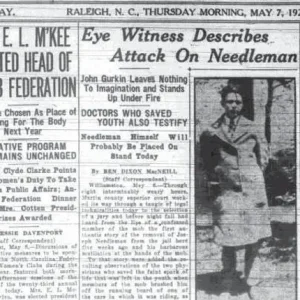
Credit: Old Martin County Courthouse History; https://oldcourthouseculturalcenter.com/courthouse-history


